PickMyCall × Amazon Nova Sonic
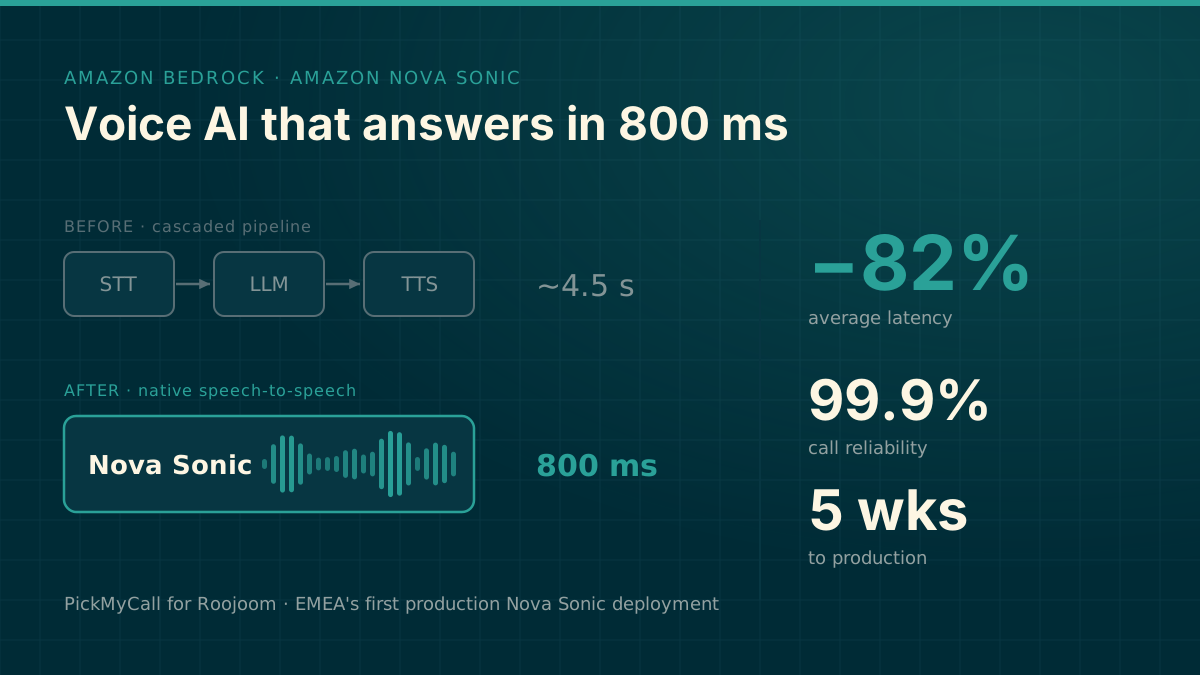
EMEA's first production deployment of Amazon Nova Sonic speech-to-speech AI, delivered for Roojoom in 5 weeks with 99.9% call reliability and 82% lower latency.
What I Learned
In a voice agent, latency changes the conversation. Callers were talking over the agent while it moved through separate transcription, reasoning and speech synthesis stages. Removing those hops made the agent quicker to respond and the calls more reliable.
The Problem
PickMyCall is Roojoom’s AI voice agent for small and midsize businesses. It answers inbound calls, captures leads, books appointments and prioritises callers.
It ran on a classic cascaded pipeline: speech-to-text → LLM → text-to-speech. Every stage added latency, and on a phone call latency is the whole product. At an average of ~4.5 seconds per turn, callers talked over the agent, and the pipeline’s timing issues sometimes dropped calls.
What We Built
We replaced the cascade with Amazon Nova Sonic, a speech-to-speech foundation model on Amazon Bedrock that understands and generates speech in a single model. There’s no transcription hop and no synthesis hop, so the agent hears the caller and answers directly.
I was the Solutions Architect on the engagement, and it became EMEA’s first production deployment of Nova Sonic, live in 5 weeks.
Results
| Metric | Before | After |
|---|---|---|
| Average latency | ~4.5 s | 800 ms |
| Maximum latency | 7 s | 2 s |
| Minimum latency | 2 s | 300 ms |
- 82% lower average latency
- 99.9% call reliability
- 5 weeks from start to production